Tactile Feedback in Virtual Reality
Improving Spatial Interaction · Bachelor Thesis · Airbus Defence and Space
Hypotheses
I investigated whether adding feedforward vibrotactile directional guidance to spatial interaction tasks:
- H1 Enables relief of the visual channel by reducing cognitive load during interaction.
- H2 Improves interaction performance in terms of task accuracy and execution time.
- H3 Improves spatial multitasking through better attention distribution.
- H4 Ensures usability by providing intuitive, supportive and distraction-free interactions.
Feedforward Vibrotactile Directional Guidance? What is that?
In short, it is a tactile guidance approach that conveys directional information before a user performs
a movement, using vibration patterns to indicate where to move next. Instead of reacting to movements (feedback),
it proactively supports spatial orientation by providing intuitive haptic cues that guide the user toward a target location.
The guidance approach was implemented in a wearable haptic prototype to evaluate whether anticipatory directional vibration
improves spatial interaction in virtual environments. The system was integrated into a VR task in which participants had to locate and
align virtual targets, allowing me to compare performance and subjective experience with and without vibrotactile feedforward cues.
Curious how the prototype looked? Or how it worked?
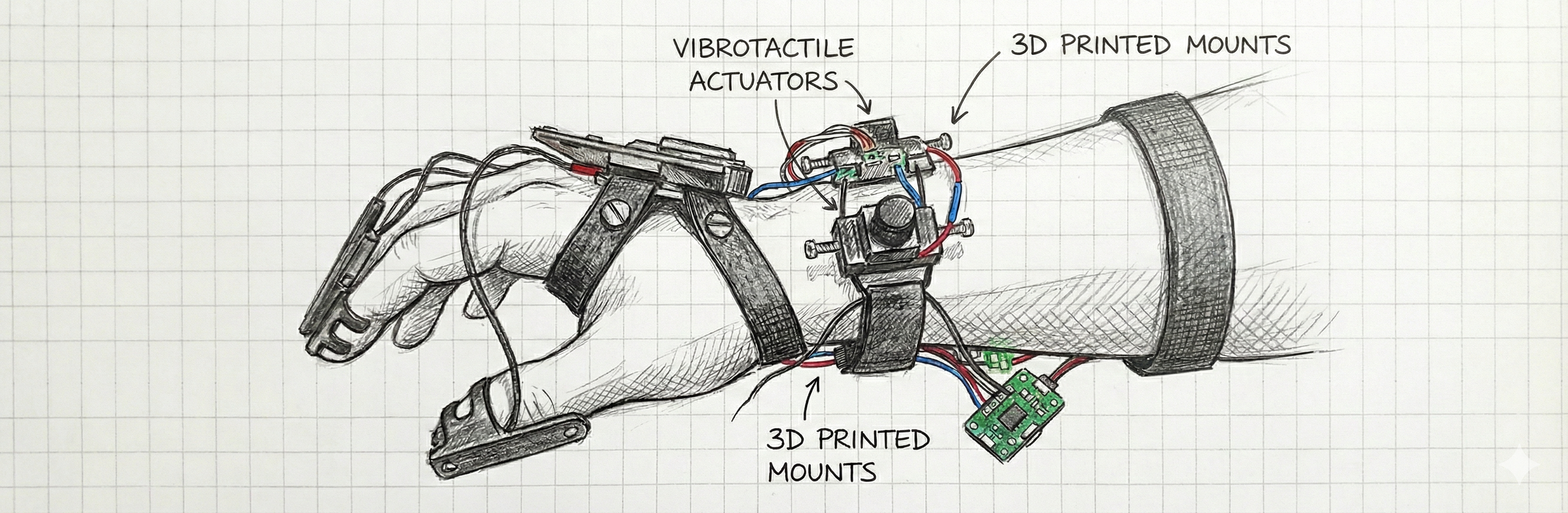
The prototype consisted of a wearable hand-mounted and wrist-mounted system combining vibration motors, a microcontroller,
and custom 3D-printed mounts. Several small vibrotactile actuators were distributed around the hand and wrist so that each motor
corresponded to a specific spatial direction relative to the hand.
Conception & System Design
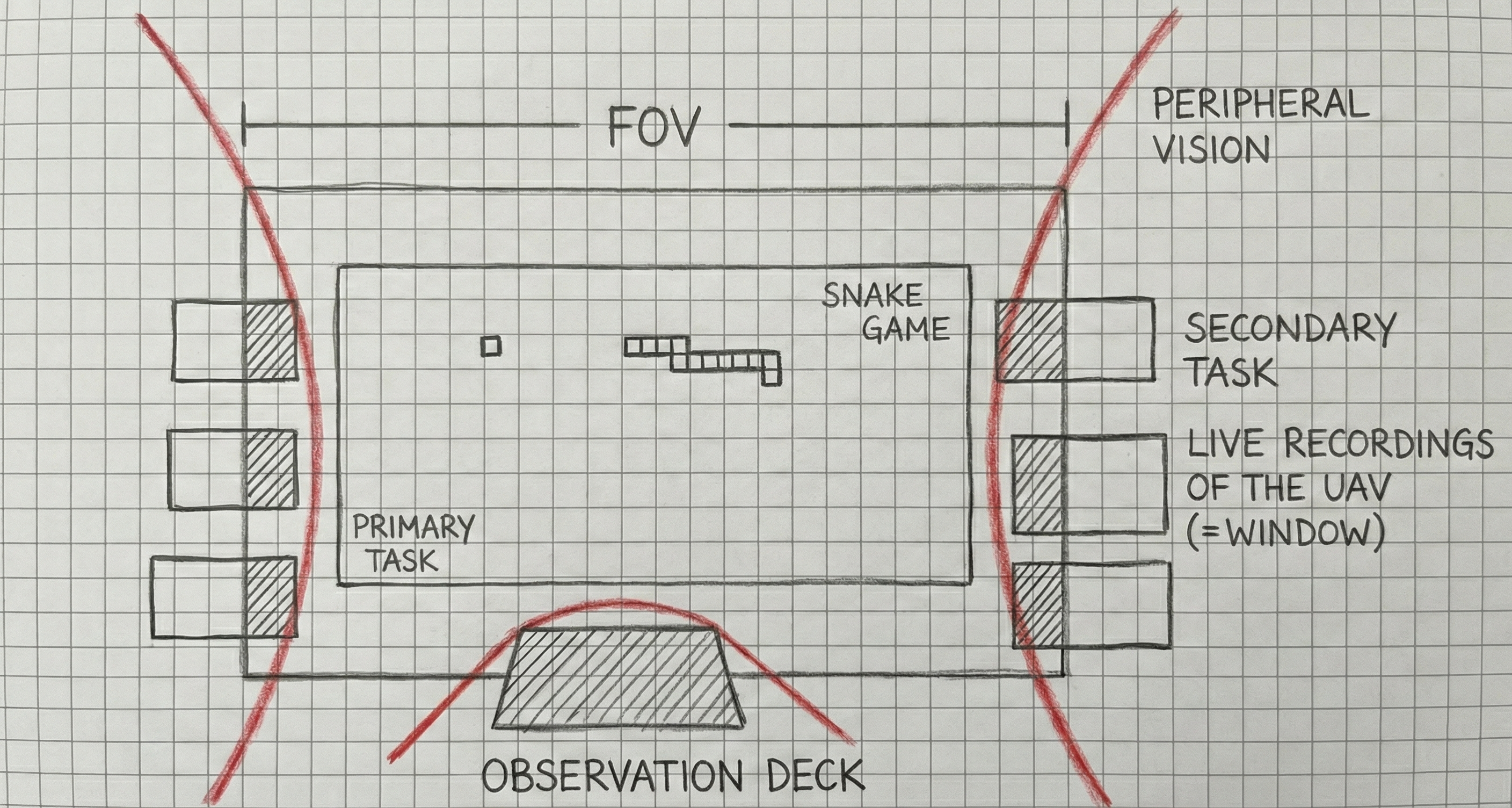
The core idea of the system was to embed a tactile information layer into a realistic spatial use case. To evaluate whether feedforward vibrotactile guidance relieves the visual channel, a dual-task scenario was designed in which users had to perform a task while simultaneously manage spatial object interaction in VR.
Primary Task for Cognitive Load
Continuous snake game interaction.
Goal: high score & low wall hits.
Secondary Task for Spatial Interaction
UAV observation in six windows.
Goal: quick reaction to 'endangered' windows & precise window placement.
System Architecture
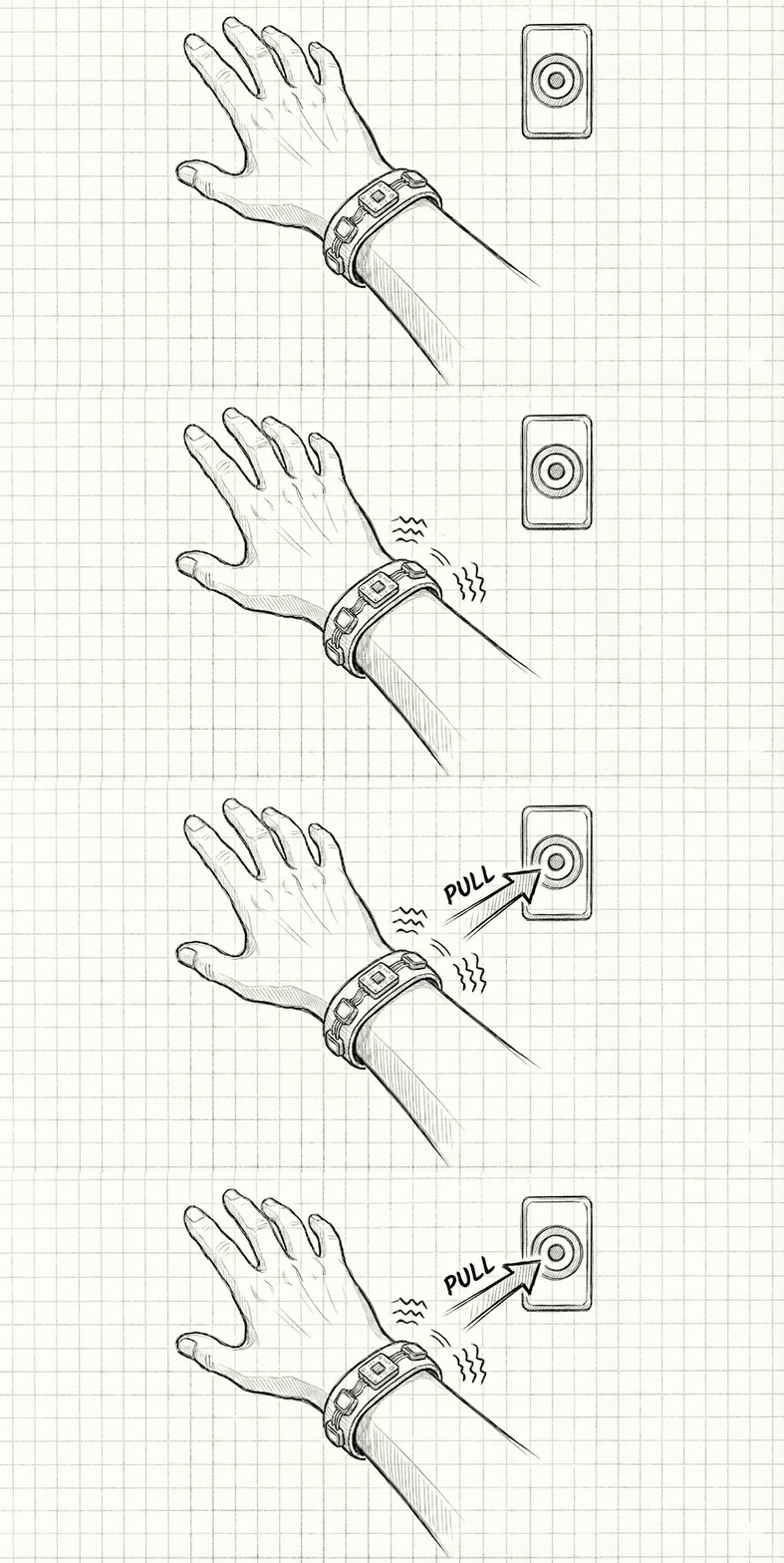
1. VR tracking captures real-time hand position
2. Direction vector to target is calculated
3. Microcontroller maps vector to actuator location
4. Corresponding vibration motor is activated
This closed-loop pipeline ensures immediate and intuitive spatial guidance.
Implementation of the VR Environment
The virtual environment was implemented to reflect a structured observation space
containing multiple UAV windows arranged within a defined area. When a window became
endangered, it visually changed state and required immediate interaction.
Figure (a)-(c) illustrates the interaction sequence for endangered windows
involving detection, selection, and precise positioning within the observation area.
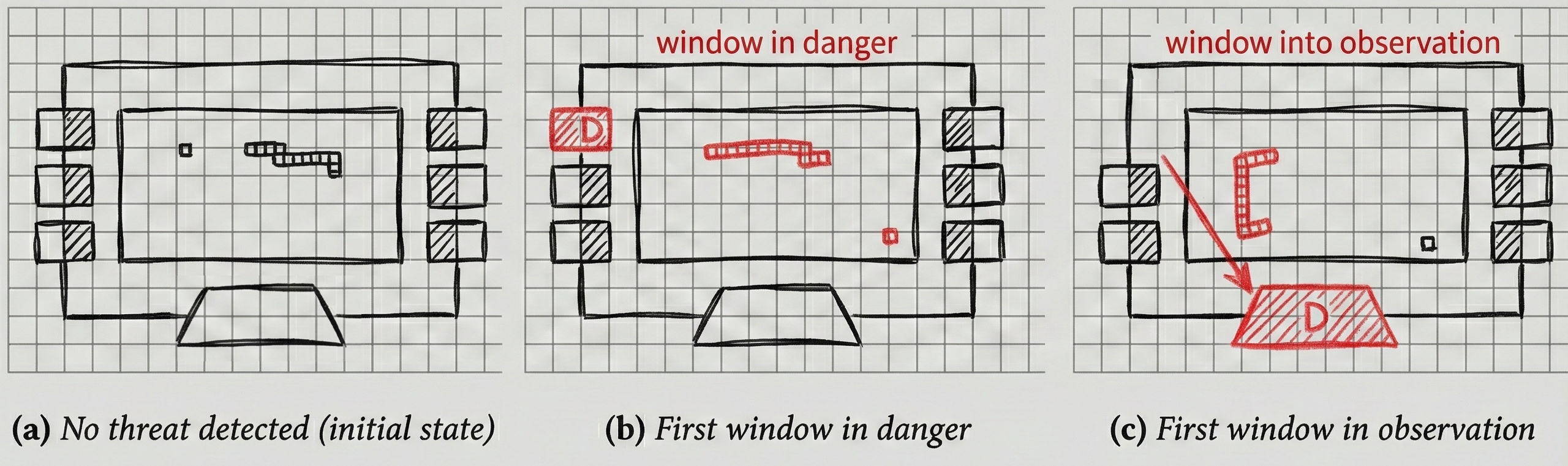
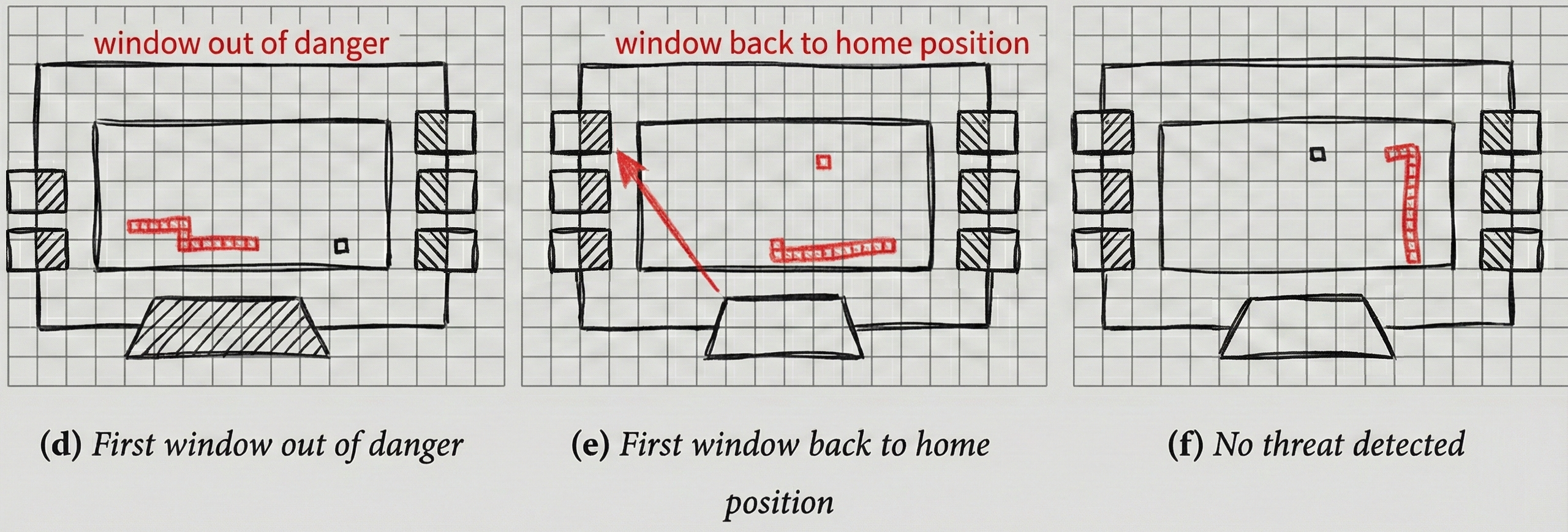
Figure (d)-(f) illustrates the interaction sequence for windows that
are no longer endangered. Participants had to detect the state change and return
the window to its predefined home position.
Throughout both interaction flows, the vibrotactile system provided directional
feedforward cues aligned with the target position, supporting spatial orientation
without additional visual indicators.
Methodology
Procedure
Curious about the user study procedure? Then, try hovering over the segments on the timeline!
Measures
Primary Task Performance (Objective)
Score · wall hits
Secondary Task Performance (Objective)
Window placement duration · accuracy · number of misplaced & successfully placed windows
Subjective
Perceived workload · perceived stress · usability
Key Findings
Performance in the primary Snake task remained stable across both conditions,
indicating that the integration of vibrotactile guidance did not interfere with ongoing visual interaction.
In the secondary task, integrating feedforward vibrotactile directional guidance significantly increased the number of successfully placed windows.
Participants also reacted significantly faster to endangered UAV windows when tactile cues were provided.
Subjective measures revealed no significant differences in perceived workload or stress levels between conditions.
Interestingly, several participants reported that the scenario with feedforward vibrotactile guidance felt more stressful because it created a sense of urgency
to react immediately to window state changes. Although the interaction task itself was simplified, the presence of vibration
made the situation feel more demanding yet more supportive, as it alerted participants to required actions.
Without vibrotactile cues, participants reported being afraid of occasionally overlooking endangered windows.
The prototype was perceived as intuitive by the majority of participants (N=14),
and most stated that it did not distract from or restrict their movements (N=11).
Participants described the system as supportive (N=15), particularly because it clearly indicated
when an action was required. Additionally, many participants reported that feedforward
vibrotactile guidance can effectively support spatial interaction in VR (N=10).
Participants also reported that vertical (up/down) cues were more difficult to identify than horizontal (left/right) guidance.
The latter was described as intuitive and easy to distinguish, suggesting anisotropic perceptual sensitivity across spatial axes.
Impact & Takeaway
The prototype was perceived as intuitive and supportive, especially regarding left/right directional cues.
Its feedforward guidance effectively supports
spatial interaction in VR environments without impairing performance in parallel tasks.
Tactile feedforward systems have the potential to be a complementary information channel in VR.